Periocular Skin Cancer Excision & Reconstruction Q&A
Clear, practical answers about eyelid (periocular) skin cancer excision and reconstruction.
Q
Why has my doctor referred me to an oculoplastic specialist for skin cancer excision?
Your doctor has referred you to an oculoplastic specialist because skin cancers around the eyelids and surrounding eye area require very precise treatment. This area is delicate and important for protecting your vision, so removing the cancer safely while preserving eyelid function and appearance is essential. Oculoplastic surgeons are specially trained in both eye surgery and plastic reconstruction, which means they can carefully remove the skin cancer and repair the area to maintain normal blinking, eye protection, and cosmetic outcome.
Q
What causes skin cancer?
The commonest causes are exposure to UV light from sunlight or sun/tanning beds and age. As you get older, your body’s immune system is not as good at removing the skin cells that have been damaged by the UV light and which can go on to become cancerous. You may have been born with a genetic condition which increases your risk of developing skin cancer. If you are immunosuppressed you may be at a greater risk of developing eyelid cancer. Rarely, exposure to environmental factors such as radiation, arsenic or coal may make you more likely to develop certain eyelid cancers.
Q
What are the different kinds of periocular skin cancers?
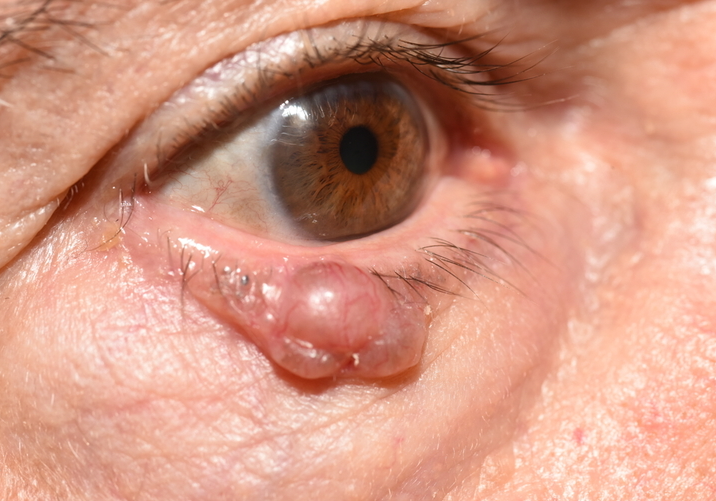
There are several types of skin cancers that can affect the eyelids and surrounding (periocular) skin. The most common is basal cell carcinoma (BCC), which usually grows slowly and rarely spreads but can cause local damage if untreated. Squamous cell carcinoma (SCC) is less common but more aggressive and has a higher risk of spreading. Melanoma is a more serious but rarer type that can develop from pigment-producing cells and may spread if not treated early. Other uncommon types include sebaceous gland carcinoma and Merkel cell carcinoma. Early detection and treatment are very important, especially around the delicate eye area.
Q
What is skin cancer excision and reconstructive surgery?
It is an operation used to remove eyelid cancer which aims to remove the entire visible tumour and to leave as much healthy tissue as possible. Small amounts of seemingly ‘normal’ neighbouring tissue will also be removed as there may be microscopic cancer cells surrounding the tumour. This tissue is checked under a microscope to see if there is any cancer left behind. Once the skin cancer is completely removed, reconstruction will ensue either on the day of or on a separate day.
Q
Why surgery may be done?
You have an eyelid cancer that, if left untreated, can continue to grow, causing damage to your eyelid and prevent it from protecting your eyeball. If left untreated, it could either spread locally destroying adjacent facial structures, along the nerves in the face or enter the bloodstream causing widespread metastatic cancer. There are many different types of eyelid cancers. The most common is a basal cell carcinoma (BCC) followed by squamous cell carcinoma (SCC). Rarer cancers include melanoma.
Q
What are the possible risks associated with skin cancer excision and reconstructive surgery?
Skin cancer excision and reconstructive surgery is generally a safe procedure. The goal of the procedure is to ensure potentially life threatening cancer is removed. Although cosmesis is paramount in any facial reconstructive surgery, the reconstructive process could lead to facial asymmetry and scarring which I will do my best to avoid. Some risks of the procedure are:
- Infection, swelling and bleeding
- Failure to remove the cancer in the first excision
- Noticeable scarring, granuloma formation
- Asymmetry
- Dry eye, corneal abrasion
- Recurrence of the skin cancer
- Wound dehiscence: the stitches come apart and need to be redone
- The need for a follow-up surgery
Q
How long prior to my skin cancer surgery should I stop using blood thinning medications?
The timing for stopping blood thinning medications before skin cancer surgery varies depending on the specific medication and your medical history. Generally blood thinners should be stopped 3-4 days prior to your surgery. Do not stop any blood thinning medication without first speaking to your surgeon and the doctor who prescribed it. They will give you clear, personalised instructions to balance the risk of bleeding with your overall health and safety.
Q
How is periocular skin cancer excision and reconstruction performed?
Periocular skin cancer excision and reconstruction is usually performed as a day procedure under local anaesthetic (sometimes with light sedation). First, the surgeon carefully removes the skin cancer with a margin of healthy tissue to ensure it has been completely excised. In some cases, the tissue is checked under a microscope during or after surgery to confirm clear margins. Once the cancer is removed, the area is reconstructed to restore the natural shape and function of the eyelid. Depending on the size and location of the defect, this may involve simple stitches, a local skin flap, or a skin graft. The goal is to fully remove the cancer while preserving eyelid movement, eye protection, and appearance.
Q
Will I need someone to drive me to and from hospital on the day of my surgery?
Yes, you will need someone to drive you to and from the hospital on the day of your surgery. For safety reasons, you will not be able to drive yourself home. It’s important to arrange for a family member or friend to accompany you and help you get home comfortably.
Q
What is the post operative care following periocular skin cancer surgery?
After periocular skin cancer surgery, you can expect some swelling, bruising, and mild discomfort around the eye, which usually gets worse over 3-4 days before improving over the next 1–2 weeks. You will be asked to apply prescribed ointment to the area for about 1-2 weeks. Keeping the wound clean and dry is important, and you should avoid heavy lifting, bending, or strenuous activity for a short period to reduce swelling and bleeding risk. Cold compresses can help with bruising in the first 48 hours.